
ElectriGate logo

Guide

Planning Permission for Electric Gates

The rule most people get wrong is the height limit, and it is lower than almost anyone expects. Permitted development rules also differ between England, Scotland and Wales, so the right answer depends on where you are.

Jump to your country

General guidance rather than legal advice. Planning rules change and interpretation varies between authorities — always confirm your position with your local planning authority before ordering.
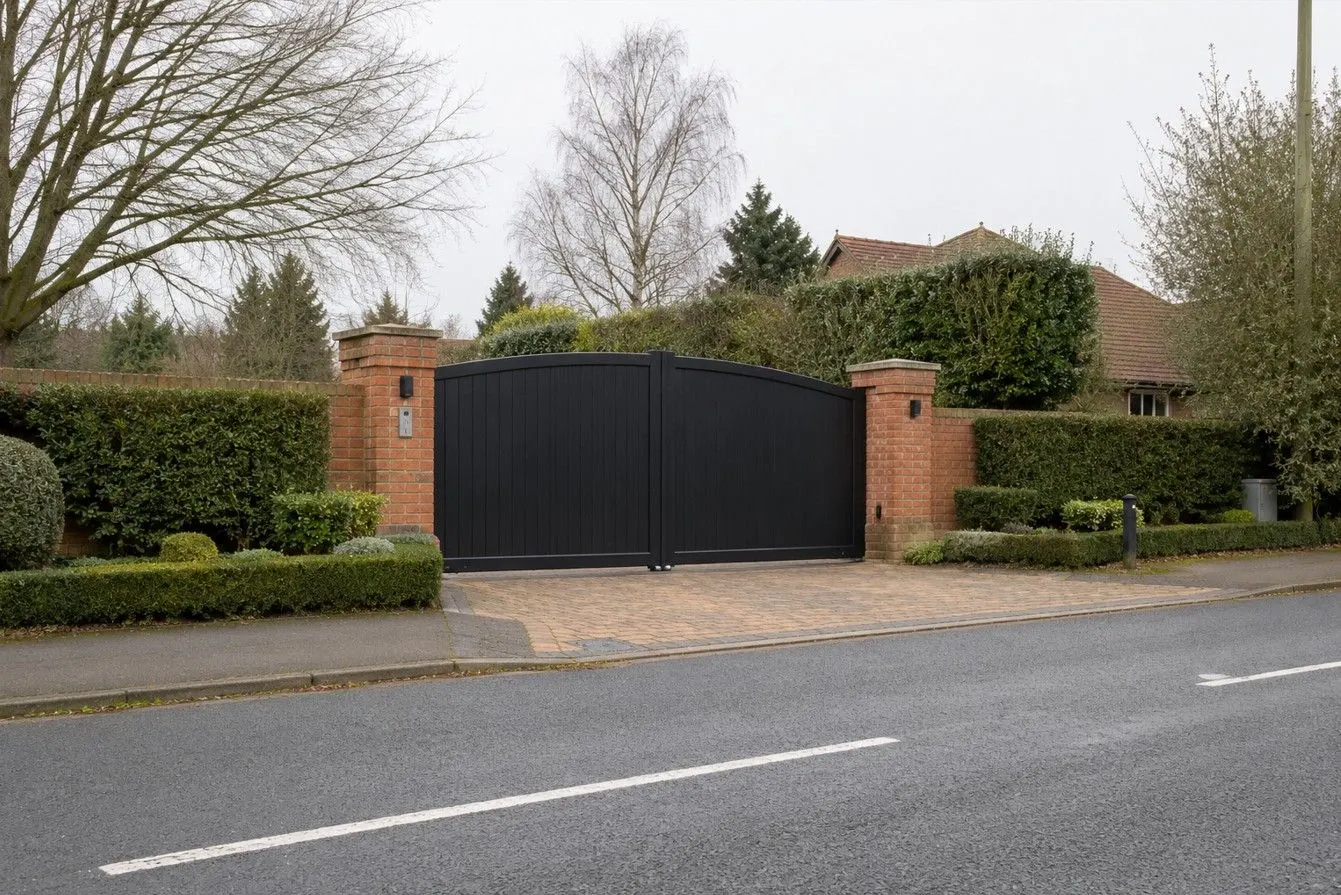
Residential electric gate entrance showing the relationship between the gate and the adjoining highway

England

Planning permission for electric gates in England

1 metre

Maximum height without permission where the gate adjoins a highway used by vehicles, or the footway alongside one. That includes the pavement.

2 metres

Maximum height without permission anywhere else on the boundary — a side or rear boundary not adjoining a vehicular highway.

These limits come from the Town and Country Planning (General Permitted Development) (England) Order 2015. One metre is roughly waist height, so in practice the great majority of driveway gates facing a road do require permission — a point most homeowners, and a fair number of installers, are unaware of.

Permitted development rights do not apply at all within the curtilage of a listed building, and they can be withdrawn in specific areas by an Article 4 direction, which some councils use in conservation areas and on particular streets. Your local planning authority holds the record of any Article 4 direction affecting your property.

On enforcement, the position changed in April 2024. For development commencing on or after 25 April 2024 the enforcement period in England is ten years, extended from the previous four by the Levelling-up and Regeneration Act 2023. In practice the difficulty usually surfaces at sale rather than through enforcement, when a buyer's solicitor asks for documentation that does not exist.

Scotland

Planning permission for electric gates in Scotland

1 metre

Maximum height without permission where the gate adjoins a road. Under Scottish law "road" includes the verge and the footway, so a pavement counts.

2 metres

Maximum height without permission in any other case — a boundary not adjoining a road.

Scotland operates under entirely separate legislation: the Town and Country Planning (General Permitted Development) (Scotland) Order 1992, as amended. The height thresholds happen to mirror England's, but they sit in a different statutory framework, so guidance written for England should not be relied on north of the border.

The wording differs in a way that matters. Scotland uses "road" as defined by the Roads (Scotland) Act 1984, which expressly includes verges and footways. England's test refers to a highway used by vehicular traffic. The practical effect is similar but the definitions are not identical, and a borderline case can turn on which applies.

Listed building consent in Scotland falls under the Planning (Listed Buildings and Conservation Areas) (Scotland) Act 1997 and is administered by your council rather than by Historic Environment Scotland in most cases. Enforcement periods also differ from England's — Scotland did not adopt the 2024 extension, so the period for operational development remains four years. Applications go to your local council's planning department.

Wales

Planning permission for electric gates in Wales

1 metre

Maximum height without permission where the gate adjoins a highway used by vehicles, or the footway alongside one.

2 metres

Maximum height without permission elsewhere on the boundary.

Wales continues to operate under the Town and Country Planning (General Permitted Development) Order 1995 as it applies in Wales, rather than England's 2015 Order. The height thresholds are the same, but planning policy in Wales has diverged from England in a number of respects since devolution, and it is administered by Welsh local planning authorities under Welsh Government policy.

As in Scotland, Wales did not adopt the 2024 change to enforcement periods, so the period for operational development remains four years. Listed buildings and conservation areas are handled by your local authority, with Cadw as the historic environment body.

Wherever you are

Rules that apply across all three countries

Some constraints have nothing to do with permitted development and apply regardless of gate height or which country you are in.

Gates must not open over a road

A gate swinging outward over a public highway, road or footway is an obstruction and is not permitted, however quiet the road. On a shallow frontage that rules out an outward-opening swing gate entirely — the alternatives are to hang it inward, fit a sliding gate, or use rising bollards.

Listed buildings need consent

Works affecting a listed building or anything within its curtilage require listed building consent regardless of height, and that is separate from planning permission. Carrying out such works without consent is a criminal offence rather than a civil planning matter.

Conservation areas add restrictions

Permitted development for gates is not automatically removed in a conservation area, but authorities frequently apply Article 4 directions that do remove it, and demolishing an existing wall or gate may itself need consent. Check with the authority before assuming.

Covenants are separate again

Restrictive covenants in your deeds are private contractual restrictions, not planning law, and they are enforceable by whoever holds the benefit — often a developer or management company. You can have permitted development rights and still be in breach of one.

Visibility at the entrance

Where an entrance meets a road, the highways authority may have views on sightlines for vehicles pulling out. This comes up more on faster roads and at new or widened accesses, and it is handled separately from the planning application itself.

Safety law is not planning law

Getting planning permission says nothing about whether the installation is safe. Force limitation, safety edges and photocells to BS EN 12453 are a separate legal requirement that applies to every powered gate. See our gate safety guide.

Confirming your situation

How to check your specific requirements

Nothing on this page tells you where your property stands. These four routes do, in ascending order of certainty.

Contact your council

The most reliable everyday route. Most planning authorities across England, Scotland and Wales run a free duty planning officer service for straightforward queries like this one.

Use the online checker

The Planning Portal covers England and Wales and includes an interactive permitted development checker for gates, fences and walls. In Scotland the equivalent is ePlanning Scotland, run by the Scottish Government.

Check for an Article 4 direction

Article 4 directions withdraw permitted development rights in specific areas, and they exist in all three countries. Your council's planning pages list any in force locally, or the planning department will confirm.

Apply for a certificate

The only route to formal legal certainty. In England and Wales it is a Lawful Development Certificate; in Scotland a Certificate of Lawfulness. There is a fee, but it is written confirmation and worth having if you may sell.

Important — please read

This page is general guidance and nothing more. It is not legal advice, planning advice, or a statement of your particular position. Planning law changes, differs between England, Scotland and Wales, and is interpreted differently by individual authorities. Local designations such as Article 4 directions, conservation area boundaries and listed building curtilage can alter the position entirely for one property and not the one next door.

Only your local planning authority can confirm what applies to your property. Where anything here conflicts with what they tell you, what they tell you is correct. Confirm your position with them in writing before ordering or installing a gate that may fall outside permitted development.

ElectriGate and the fabricators we work with do not provide planning advice, do not make planning applications on your behalf, and accept no responsibility for planning outcomes. Responsibility for obtaining any necessary consent rests with the property owner.

If you do need permission

What applying actually involves

01

Ask before you design

A short conversation with the duty planner before anything is drawn is worth far more than an appeal afterwards, and it costs nothing.

02

Householder application

A gate is normally a householder application. You will need a location plan, a block plan and drawings of the proposed gate, which your fabricator can provide.

03

Allow eight weeks

The determination period for a householder application is generally eight weeks, and longer where consultation is needed. Factor it in before agreeing an installation date.

04

Design to suit

An open design in proportion to the existing boundary is generally received better than a tall solid panel, particularly in conservation areas.

Common questions

Planning permission questions

Where the gate adjoins a road or highway used by vehicles, yes — and that includes the pavement alongside it. One metre is roughly waist height. It surprises almost everyone, and it means most driveway gates facing a road do technically need permission, in all three countries. Confirm your own position with your planning authority.

Some will have permission. Others were installed without it and have never been challenged, which is common but is a risk rather than a plan. Enforcement is discretionary and authorities rarely pursue a domestic gate, but the position tends to surface at sale when a buyer's solicitor asks for documentation.

The authority can require removal within the enforcement period, which differs by country — ten years in England for development commencing on or after 25 April 2024, and four years in Scotland and Wales. Retrospective applications are possible but not guaranteed. Where the property is listed, unauthorised works are a criminal offence rather than a planning matter.

The height thresholds are the same, but they sit in three separate pieces of legislation administered by different authorities, and the surrounding rules have diverged. Enforcement periods are the clearest example. Guidance written for England should not be relied on in Scotland or Wales.

Apply for a Lawful Development Certificate in England or Wales, or a Certificate of Lawfulness in Scotland. There is a fee, but it is formal written confirmation from the authority that what you propose is lawful. Particularly worth having if you may sell the property, since it is the document a buyer's solicitor will ask for.

Generally an easier proposition, since a bollard sits flush with the ground when lowered and alters a frontage far less than a permanent structure. That makes it worth considering where a gate is unlikely to be approved — though it still needs checking with your authority. See our electric bollards page.

No. Your fabricator will flag when something looks likely to need consent and can provide drawings of the proposed gate, but the application is made by the property owner and we do not give planning advice. What we will not do is tell you it is fine when it may not be.

Related guides

Also worth reading

Gate safety standards

BS EN 12453, force limitation and safety edges — a separate legal requirement from planning.

Rising bollards

The alternative worth considering where a gate is unlikely to get consent.

What it will cost

Real price ranges by gate type, and the factors that move a job within them.

Where we work

Find your local fabricator and check whether your area is covered.

Send us an enquiry using the form below and your local fabricator will flag anything that looks likely to need consent — though confirming it remains a matter for you and your planning authority.

Areas we cover

Find your local fabricator

Choose your region to see every town we cover, or go straight to one of our busier locations below.

By region

Lincolnshire

19 locations

Cambridgeshire

16 locations

Norfolk

20 locations

Essex

21 locations

Lothians

11 locations

West of Scotland

14 locations

Fife

3 locations

Forth Valley

3 locations

Scottish Borders

2 locations

Popular locations

Lincoln

Lincolnshire

Boston

Lincolnshire

Grantham

Lincolnshire

Grimsby

Lincolnshire

Cambridge

Cambridgeshire

Peterborough

Cambridgeshire

Ely

Cambridgeshire

Huntingdon

Cambridgeshire

Dunfermline

Scotland

Don’t see your town? Every location we cover is listed on our areas we cover page, or send us your postcode and we will confirm.

Ready to get started?

Get your free electric gate quote today

Tell us your requirements and we'll match you with the best local installer - usually within 24 to 48 hours.

ElectriGate logo

ElectriGate connects homeowners and businesses with trusted local electric gate installers across England and Scotland. All enquiries are free with no-obligation.

All Rights Reserved | ElectriGate  - Supporting Independent Local Installers

© 2026

ElectriGate is a Trading name of My Business Buddies.

Company Number:16641926

Registered Address: 4 Marlborough Road, Woodthorpe, Nottingham NG5 4FG